

Why Swifties Are the Real Problem
or 'why i stopped wearing my friendship bracelet'
There’s a particular kind of opinion that doesn’t feel like an opinion at all.
You know the type: “I’m a Swiftie.” Not just “I like Taylor Swift,” or “I’ve had Folklore on repeat,” but something more total. A statement of identity or belonging.
But here’s what I want to suggest:
An Eras friendship bracelet, or saying “I’m a Swiftie” isn’t just a fact about musical preference.
It’s a pattern. A many - woven out of songs, memories, posts, vibes, colours, para-social attachment, merch, aesthetic choices, memes, Reddit threads and heartbreaks.
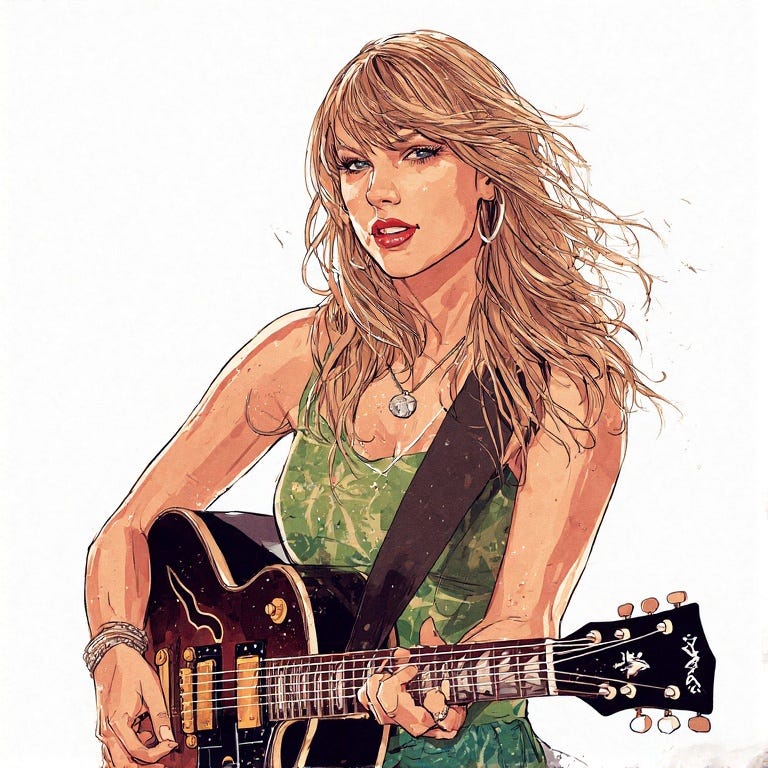
And you’re the one turning all that into a single thing - a role or a self.
And that process?
That’s what Buddhism calls samudaya.
⸻
Craving as construction
If you’re unfamiliar with the term, samudaya is the second of the Four Noble Truths - usually translated as the cause of suffering. It’s often defined as craving, and in many contexts that means obvious stuff: clinging to pleasure, avoiding pain, trying to freeze things in place.
But craving isn’t always that direct, in fact, sometimes it arrives in disguise.
Sometimes craving shows up as a personality.
This is where I want to bring in a helpful distinction from philosopher John Searle, who pointed out that we use the words subjective and objective in two different ways. One is about how things exist (that things depend on a mind to be real, the way a headache is subjectively experienced) and the other is about how things can be known (that is, from a specific perspective).
That second kind of subjectivity about knowing - epistemic subjectivity - describes the status of an opinion. But a lot more is in this category than we might usually think. Basically anything personal.
An obvious way it shows up is when we say, with complete conviction:
“Taylor Swift is a genius and if you don’t get it that’s on you.”
It’s one perspective, sent outward - from the one to the many.
But another way we do this is with our personalities. And most of the time, we don’t even notice we’re doing it.
We think we’re being ourselves - but we’re actually performing cravings.
⸻
Champagne problems
The Buddhist view is that craving isn’t just about wanting things - it’s about mistaking projection for truth. A felt need, dressed up as a description of how the world really is.
And that’s what’s happening here:
• We feel something - joy, resonance, recognition.
• We build a story around it - “this matters,” “this defines me.”
• We project that story outward - into posts, arguments, TikToks, dinner conversations and Spotify Wrapped.
• And we forget that it all started as a subjective spark - a personal moment that needed no justification in the first place.
Samudaya, in this light, is the transformation of experience into narrative - and the insistence that this narrative must be real, shared, and essential.
We take a passing thought and use it to scaffold a personality.
It’s not just “I enjoy Taylor Swift.”
It becomes:
“I am the kind of person who loves Taylor Swift.”
“I’m part of the world that gets it.”
“If you don’t, that means something about you.”
And now we’re suffering - not because we love something, but because we’ve turned that love into a platform and a point of view that can be affirmed or rejected.
That’s the cost of craving: we make ourselves real, but only by doubling down on something that was never stable to begin with.
⸻
The bait and switch was a work of art
At this point I should confess a bait and switch - Swifties aren’t the problem at all, of course
I’m one myself, in most of the ways I’ve described above. I’ll defend All You Had To Do Was Stay to anyone who’ll listen. I’ve cried at Invisible String. I think Folklore is a better emotional map than most self-help books, and I used to wear my rainbow coloured Karma friendship bracelet around town.
This isn’t really about Taylor Swift.
Because what’s really at stake here is much broader. It’s not just fandom. It’s the entire tendency to build outwards from the self, and to mistake those constructions for something fixed and essential.
It’s the craving to be seen a certain way and to define ourselves through our taste or our tribe.
It’s the urge to mean something.
⸻
Some perspective
The good news is you don’t need to renounce all opinions or become a monk. This isn’t about giving up desire - it’s about recognising desire when it hides inside identity.
That’s samudaya.
One, acting on the many.
A view, or personality, pushed outward. It’s pushing instead of ‘letting be’.
And the antidote isn’t passivity. It’s perspective. A quiet noticing that the stories you’re telling about who you are - the labels, the affiliations, the brands - are optional. You can drop them, even if only briefly. You can just hear the song. That’s the real heart of fandom - not the story you tell about it, but the moment you let the music move you in the first place.
That might be the real path: not to stop wanting, but to stop insisting.
To let the moment breathe - like “you can hear it in the silence,” rather than trying so damn hard.
Anyway, I’m off to listen to Folklore.
We crave so much to feel like we belong, sometimes that craving is even stronger than our own sense of identity. Interesting subversive read.