What Happens When a Negative Meets a Positive?
Yup, there's only a limited number of things that can happen...
Let’s take Positive and Negative as fundamental forces.
Positive and negative what? Well I don’t think it matters.
Because as I see it, there are only four possible ways positive and negative things can interact:
Positive on Positive
Negative on Positive
Negative on Negative
Positive on Negative
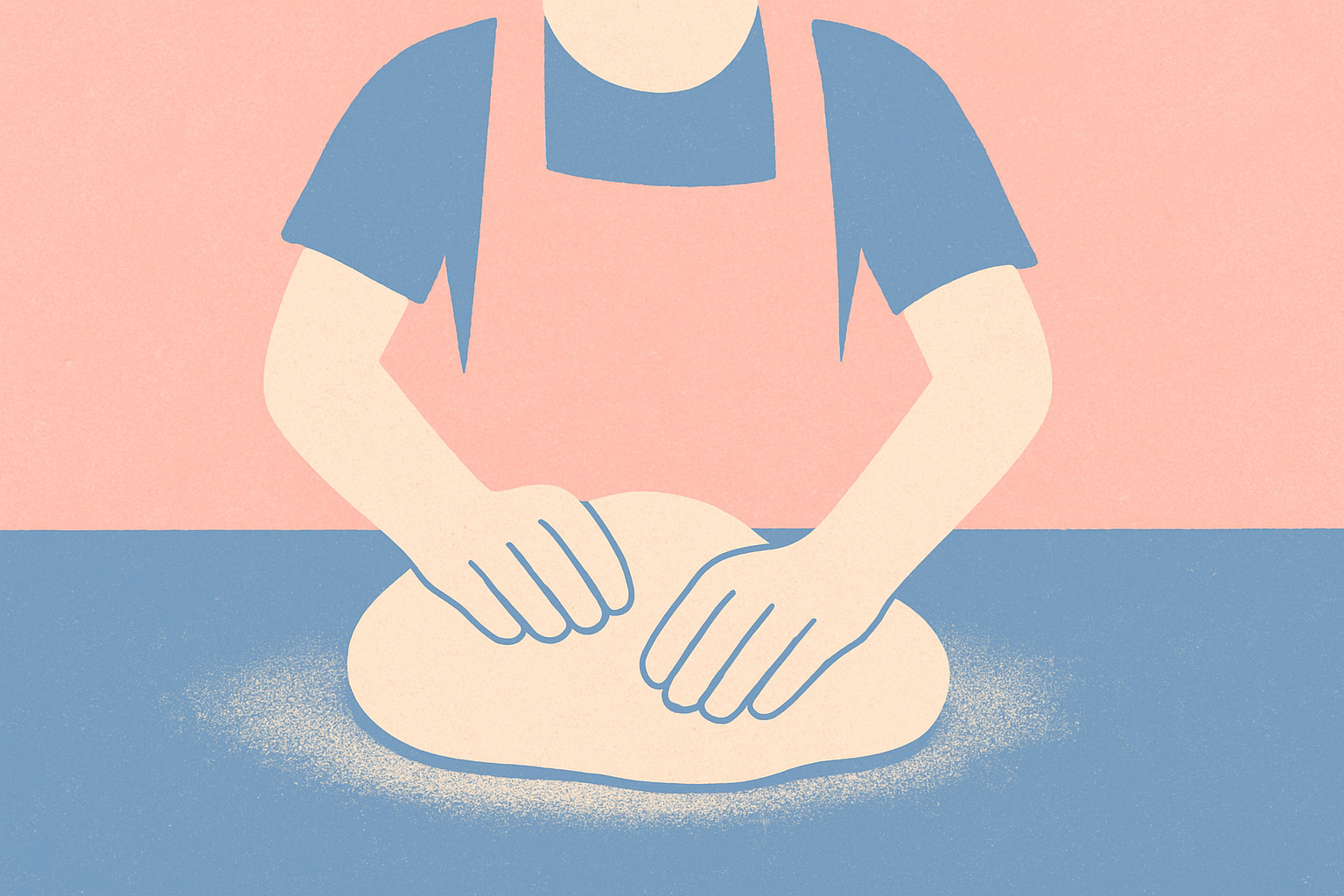
Let’s picture this using something familiar. Say we’re making scones. The dough is positive, and the air in and around it is negative.
Now, let’s get our hands messy.
1. Positive on Positive – Normalisation
You press more dough onto the dough. It sticks, it gets bigger, but it stays one lump. No matter how much you add, it just becomes the dough, a single thing.
That’s multiplication – a positive reinforcing a positive. It makes things smoother, denser, more uniform. Everything averages out. One handful’s the same as another.
This is what reality does when it folds into itself – self-reinforcing presence. It keeps growing but always renormalises to one.
2. Negative on Positive – Relativity
Now you cut the dough or break it into bits. Knife or fingers, doesn’t matter. You’ve brought absence into contact with substance. Suddenly you have unbaked scones, each surrounded by air.
That’s division – comparison and perspective. Each new piece exists only because of the space that separates it. The moment you slice, you invent “this one” and “that one.”
The first time you cut something, you also invent context – a world of relations.
3. Negative on Negative – Subtraction
Here we add space to space. The gaps widen; the dough thins. More air means smaller scones, relatively speaking. The world hasn’t lost its substance, but proportionally it feels lighter, stretched.
That’s subtraction – absence acting on itself. The result isn’t nothing, but it leans that way. Presence gets rarer; what remains is mostly spacing.
4. Positive on Negative – Addition
Now you put the scones in the oven. The heat makes them rise into the gaps between each other. The air gives way; the dough fills it evenly. It doesn’t matter which scone expands first – the space levels out.
That’s addition – a positive meeting a negative until the field evens out. Direction stops mattering.
All four – multiplication, division, subtraction, addition – aren’t really about numbers. They’re about how presence and absence relate. Dough and air never stop trading roles. One swells, one parts; one thins, the other returns.
Every scone is a tiny cosmology – one ball of dough in one room of air. Call it arithmetic, geometry, or just afternoon tea. The recipe never changes: positive and negative, shaping each other in four stable ways.
My whole blog is about JUST this. This four-fold pattern shows up everywhere because any time you say ‘there’s four types of x’ then almost certainly it will mirror these four movements. That’s because, in turn, the concepts they are built on - positivity and negativity - are such fundamentals.
Now. Who’s for a scone?