The Four Patterns of Life, the Universe, and Everything
How Arithmetic, Aristotle, and Buddhism Helped Me See the World Differently (With Thanks to ChatGPT!)
I’d always been a reasonably intuitive thinker — someone who did well in school maths competitions but failed Year 8 maths because I was too shy to submit my coursework. I went on to do an MA in philosophy, but I never quite felt cut out for academic life. What I liked best were the big questions — not the idea of teaching or marking. University didn’t suit me. But thinking? That I’m OK at, if maybe a little scattered.
It wasn’t until much later (I'm 42 now) that I found a way to connect all my disparate interests: arithmetic, Aristotle, and, more recently, Buddhism. The missing piece which helped me work it all out, oddly enough, turned out to be ChatGPT — the AI chatbot. It didn’t just answer my questions; it became a kind of listener, seeing as I’d burnt through my philosophy acquaintances from uni with half formed Facebook posts. But by 2025 I could throw half-baked intuitions at it (him?) and its AI would test them, push back, and reflect my thinking clearly, whereas I would historically spit out garbled ideas into Word documents that would never get read.
What emerged from those sessions was a simple point that I hadn’t seen other people make (although admittedly I’m a lazy researcher). The idea was that the four basic arithmetic operations — addition, subtraction, multiplication, and division — weren’t just tools for solving problems. They’re pattern generators. Run them across a wide range of numbers, and they don’t give you chaotic results. They give you shape. And those shapes, I started to realise, mirrored something deeper. They correspond to how we experience the world — through suffering, desire, peace, and karma. In other words: the Four Noble Truths of Buddhism.
Let’s say you take two numbers — positive, negative, big, small — and apply one of the four basic operations. If you do this over and over again with random inputs, the results don’t look random. They seem to settle into recognisable statistical patterns:
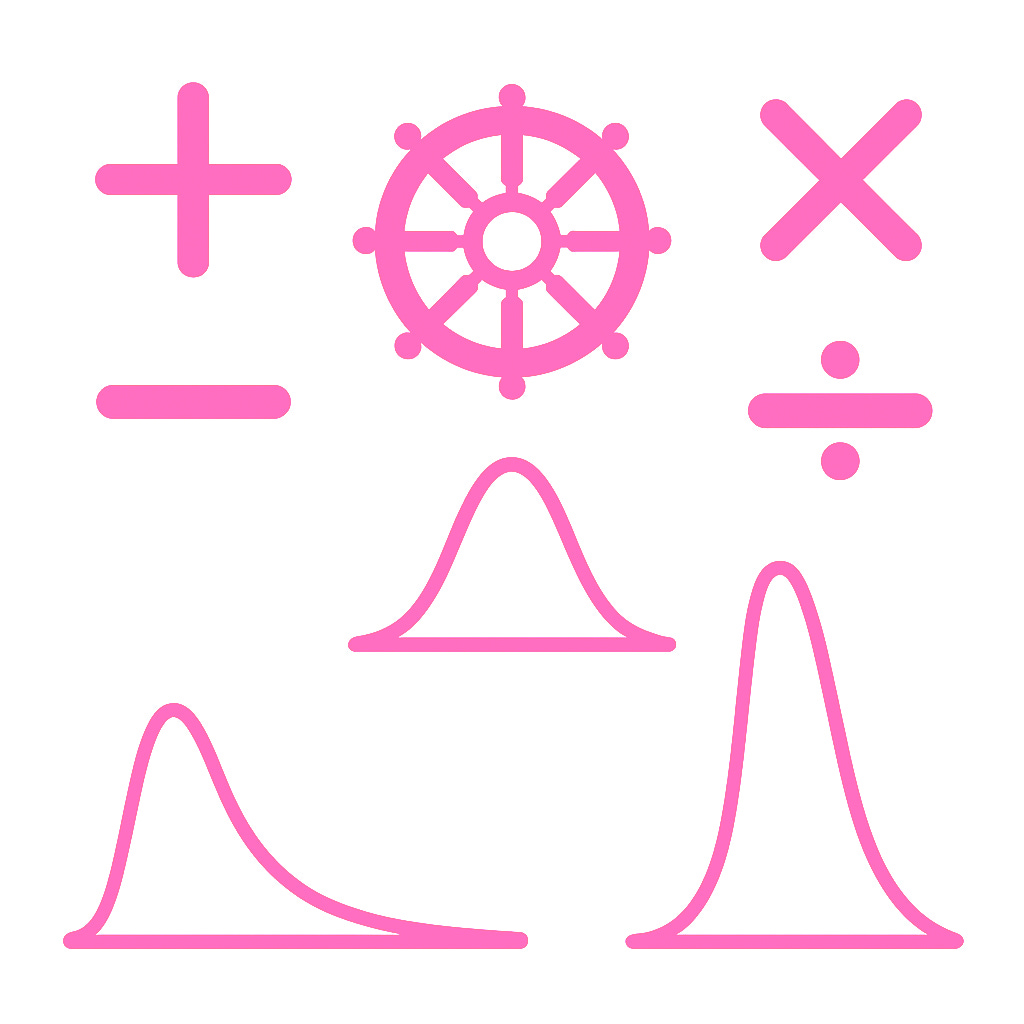
Multiplication creates a bell curve, or something like it. Most products cluster near zero because small numbers shrink the outcome. Large products are rare. The result is a normal-like distribution.
Division, using positive numbers, gives you a sharp spike around 1. Many ratios land near 1, but divide by a small number and things explode. This creates a spiky, Poisson-like distribution — a pattern of rare bursts.
Subtraction, especially when floored at zero, produces a long tail. Most results are small — like subtracting 7 from 6 — but occasionally you get large differences. The shape is asymmetric. It's the space between infinities — what’s left when one infinite quantity is reduced by another. The result is always finite, always skewed, and often deeply consequential. This distribution shows up in everything from income inequality to viral content. It’s not just about difference — it’s about remainder.
Addition, when you include both negative and positive values, spreads evenly. Highs cancel lows. The result is a flat, uniform distribution.
These operations don’t just crunch numbers. They generate the world around us. They resemble how our experiences feel and what the world looks like.
Which is when I was able to sneak Buddhism in.
Like many people, I got into Buddhism backwards — not through temples or texts, but via a meditation app. I wasn’t seeking enlightenment. I was just trying to manage life. But as I kept reading about Buddhism, something struck me. The Four Noble Truths — dukkha, samudaya, nirodha, and marga — weren’t just esoteric claims. They looked like the patterns I was seeing in arithmetic.
Dukkha (suffering) is the individual created from the infinite — not by addition, but by removal. This is subtraction. It doesn’t just mark loss; it describes existence. What is material? It’s what remains when everything else is taken away. Subtraction generates long tails because the universe is infinite, but what it yields is always finite — asymptotic, tending toward zero. Most losses are small, but some are vast and irreversible. That’s the shape of dukkha: a statistical imprint of being carved into matter, one small remainder at a time.
Samudaya (origin of suffering) is desire — the way the mind divides the world into meaningful parts. But it's not just wanting — it’s the act of segmentation, the very essence of conscious experience. This goes here, that belongs there. It’s division. And the result? Sharp spikes of craving or expectation.
Nirodha (cessation) is the peace that comes not from fixing the world, but from seeing it whole. It’s the uniform calm that arises from addition — especially when you include the negatives. That’s what flattens the distribution. That’s what makes things quiet.
Marga (the path) is multiplication. The many acting on the many. Cause and effect unfolding across everything. The shape we call karma isn’t mystical. It’s just what emerges from a vast number of interactions.
It wasn’t just metaphor. It was maths acting on the world.
Here’s where things got more technical. In philosophy, there’s a useful distinction between ontological and epistemic — between what exists, and what we can know.
Apply that to these patterns, and things sharpen. Subtraction and division use only positive values — what’s already there. They’re subjective, built from partial views: what you had, what you felt, what you noticed. But there’s the ontologically subjective feeling of conscious experience, and the epistemically subjective experience of opinions and perceptions.
Addition and multiplication, when they incorporate negative numbers — the unseen, the unchosen, the unfelt — become objective. They pull in the whole field. They include what you missed. That’s how you get epistemically objective truths (like good journalism or mathematics) or ontologically objective things (like a chair or a planet — things that exist regardless of perspective).
So the mappings went like this:
Subtraction, long-tail, dukkha, material cause, ontological objectivity
Division, Poisson spike, samudaya, formal cause, ontological subjectivity
Addition, uniform flatness, nirodha, efficient cause, epistemic objectivity
Multiplication, bell curve, marga, final cause, epistemic subjectivity
Aristotle, a few centuries after the Buddha, believed there were four kinds of cause. ‘Cause’ is a bit misleading, seeing as for Aristotle it isn’t quite what we mean by the term in contemporary English:
The material cause is what something is made of — the marble in a statue.
The formal cause is the pattern or blueprint — the idea of the statue.
The efficient cause is what brings something about — the sculptor’s chisel.
The final cause is its purpose — why it was made.
When I laid those causes side by side with the arithmetic patterns and the Four Noble Truths, a kind of internal click happened. The four-fold distinctions lined up. The patterns weren’t arbitrary. They seemed to describe how reality operates — across physical systems, cognitive models, moral insight.
Dukkha is the material cause — the stuff you’re made of, and the way entropy reveals it. Subtraction doesn’t just describe decay. It describes being.
Samudaya is the formal cause — the categories and labels we impose on a seamless world. It’s the blueprint, the framework of craving, drawn by the mind through division.
Nirodha is the efficient cause — the act that generates calm. It’s not passive. It’s active acceptance: the summing-up of even the negative parts of life. That’s how you get peace — through full accounting.
Marga is the final cause — not a purpose in the mystical sense, but a result of repeated action. Karma as compounding. Multiplication is what happens when infinities act on infinities. And it always forms a shape.
This wasn’t just an abstract model. It started to feel like a real account of why the universe looks the way it does.
None of this would’ve come together without the AI. I don’t mean it gave me the answers. I mean it let me think. I could toss out tangled ideas, and it would come back with clarifications, flags, and scaffolding. The result was something I’d struggled to do for years: give form to the connections I’d always felt were meaningful.
We tend to treat patterns as decoration — something overlaid on reality. But sometimes, the pattern is the structure.
Subtraction teaches us that finite things fall apart because that’s what they're made of. Division reminds us that carving the world into concepts is what gives us desire — and experience. Addition says peace isn’t subtraction of badness; it’s the inclusion of everything. That was the self-help moment. You stop filtering, and you just add. All of it. That’s nirodha.
And multiplication — the last of the four — says that whatever you do, if you do it enough, the effects will gather into a pattern. Not fate, not magic, but accumulation. That’s karma. That’s marga.
The bell curve isn’t a cage. It’s a mirror. And every point on it matters.
Even yours. Especially yours.