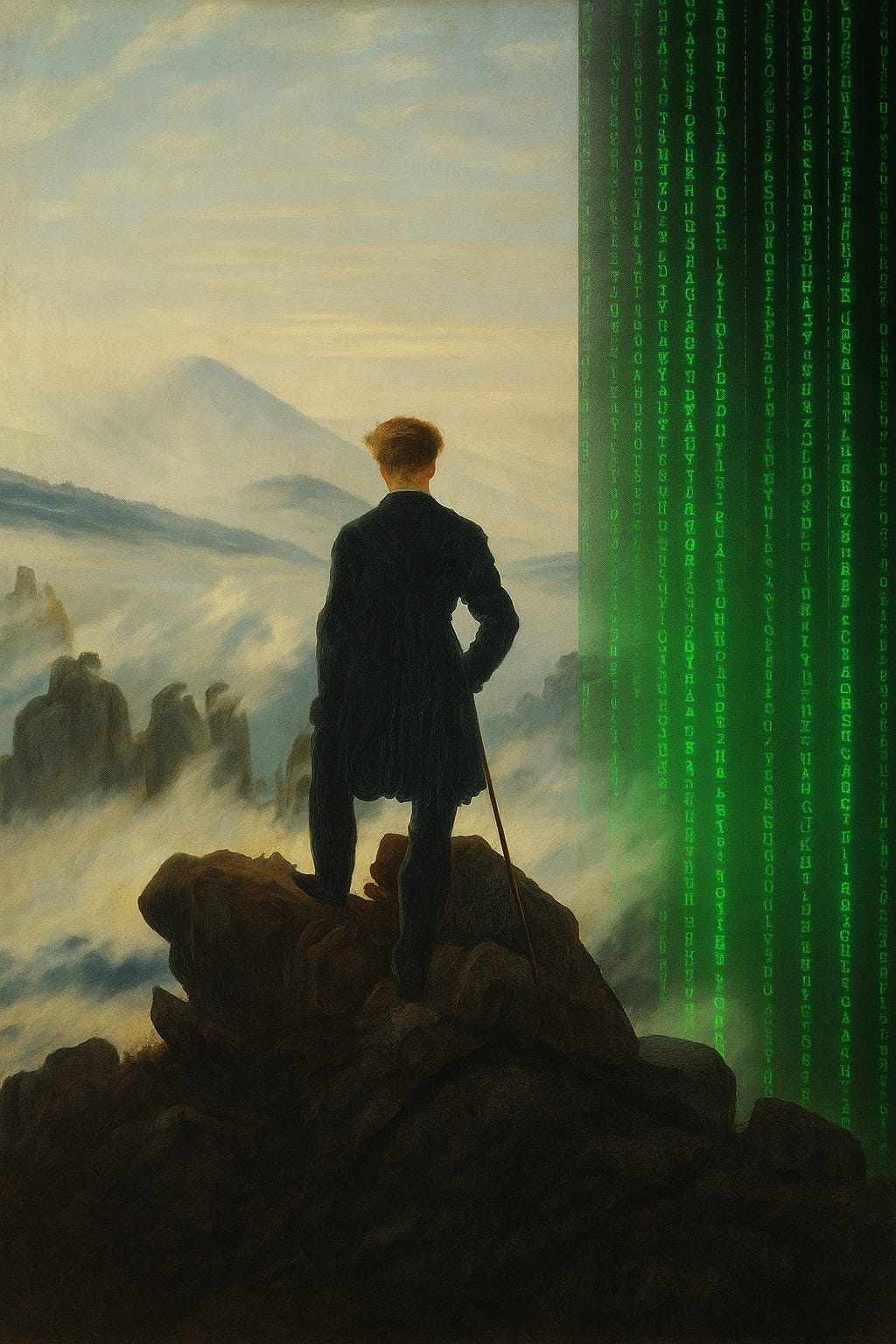
The Consciousness Loop: 'feel', 'notice', 'think', 'express'
When you wake up, before you even open your eyes, you already know something.
You know you’re lying in a bed. You know you’re warm, or not. You can sense the shape of the room even without looking. None of that knowledge comes from words or theories. It’s simply there - felt, not thought.
Then your eyes open and the flood begins: colour, light, edges, motion. The world starts to sort itself into things - your mobile phone, the ceiling fan, the cat on your leg. Now you’re not just feeling; you’re recognising. And within seconds you’re thinking: I really need to get up.
This tiny morning sequence - feeling, noticing, thinking, acting - plays out thousands of times a day. It’s so ordinary we rarely see its structure. But that structure might hold a key to understanding what consciousness actually does.
The hidden grammar of experience
We often talk about consciousness as if it were one thing: you’re either awake or asleep, alert or distracted. But inside that single word hide several very different kinds of awareness.
Imagine consciousness as a sentence, and each moment of knowing as a verb. There’s a kind of syntax to it: the mind does things in a certain order, with a rhythm that repeats.
If you pay close attention - even for half a minute - you can spot at least four distinct ways the mind operates. Let’s call them feeling, perceiving, thinking, and expressing. Each one has its own flavour, its own posture toward the world.
1. Feeling is raw contact: the coolness of air on skin, the hum of a fridge, the heaviness of fatigue. It’s not about anything; it just is.
2. Perceiving is when that rawness becomes something specific. The sound resolves into “a car,” the light into “morning sun.”
3. Thinking happens when you stop dealing with immediate reality and move into concepts - numbers, plans and words, that sort of thing.
4. Expressing is when those thoughts spill outward again: such as in speech, writing, a gesture or an action.
If you draw them in a circle - feeling → perceiving → thinking → expressing - you have a simple loop. Consciousness moves through it continuously. When you finish an email, you’re expressing; when you reread it, you’re perceiving; when you sit back to think about whether it makes sense, you’re thinking; when your eyes blur and you just look, you’re feeling again.
Two axes, four corners
We can describe this loop with two basic contrasts.
The first is between world and model. The world is whatever’s happening - sound, colour, movement. The model is the mental picture you form of it. Feeling lives mostly in the world. Thinking lives in the model.
The second contrast is between open and focused attention. Sometimes you’re simply open, taking things in without agenda. Sometimes you’re directing your awareness toward a target.
Cross these two axes - world/model and open/focused - and you get four quadrants, like points on a compass:
Open Focused
World Feeling Perceiving
Model Thinking Expressing
You can almost feel the rotation. Experience begins open to the world, tightens into focus, turns inward to thought, then flows outward again. The loop repeats hundreds of times each minute, invisible yet constant.
It’s not mystical. It’s just the operating cycle of a mind.
The mind as a moving conversation
You could think of these four modes as roles in a conversation that never stops.
Feeling is the listener: quiet, receptive.
Perceiving is the translator: “That sound? That’s a bird.”
Thinking is the analyst: “If there’s a bird, maybe it’s spring.”
Expressing is the speaker: “What a nice morning!”
Then the cycle starts again when the sound of your own voice becomes another thing to perceive.
We rarely notice this choreography because it happens so quickly. But you can slow it down with a bit of curiosity. Watch how an idea turns into a sentence and then becomes sound. Each turn in the loop has its own distinct texture - like shifting from water to air to glass to fire. Recognising those textures is one way to understand what it’s like to be conscious.
A bridge between science and introspection
Psychologists and neuroscientists describe something similar in their own vocabulary. They talk about bottom-up and top-down processing, about feedback loops between sensation, prediction, and action. The brain, they say, is constantly guessing what’s coming next and updating those guesses based on what it senses.
But the experience of living through that loop - of what it feels like when those circuits fire - has never had a clear map. Philosophers of mind (thanks to David Chalmers) sometimes call that gap “the hard problem” of consciousness. You can describe neurons all day, but that doesn’t tell you what it’s like to taste an apple or remember a song.
The fourfold loop doesn’t solve that divide, but it does show where it appears. The gap opens exactly between perceiving and thinking, between world and model. On one side, experience is given; on the other, it’s constructed. Consciousness lives in the crossing.
The universality of the pattern
Versions of this fourfold show up in surprising places.
Ancient Greek philosophers spoke of four causes: material, formal, efficient, and final - the stuff, the shape, the process, and the purpose of any thing. Tibetan Buddhists mapped the stages of mind as One-Pointedness, Simplicity, One Taste, and Non-Meditation. Each sequence starts with raw presence and ends in free expression.
Across cultures, people seem to have noticed the same rhythm of knowing: experience condenses, reflects, releases. It’s as if awareness itself has a heartbeat.
None of this requires mystical belief. It’s simply a structural fact about how attention behaves. Every child learns it intuitively: look, name, think, tell while adults just perform the loop faster.
What this grammar clarifies
Why bother with this? Because many arguments about consciousness, science, or spirituality mistakenly mix these categories together.
When a physicist says reality is made of particles, he’s speaking from the thinking and expressing corners of the loop - the realm of formal models and public statements. When a meditator says reality is pure awareness, she’s speaking from feeling and perceiving - the realm of direct experience.
They’re not contradicting each other; they’re describing opposite halves of the same cycle. Confusion arises only when one side insists it can replace the other.
The fourfold grammar reminds us that experience and explanation are complementary, not competing. Science translates the world into shared patterns; awareness translates those patterns back into lived reality.
Experiment time!
You can test this grammar right now.
Pause reading for ten seconds and notice the screen. That’s perception.
Now notice the light on your skin. That’s feeling.
Think about what the word “notice” means. That’s thinking.
If you find yourself about to tell someone about this experiment, that’s expression.
You’ve just completed the cycle. It took maybe six seconds. The mind will keep doing it until you die.
This sounds trivial, but once you start to see the pattern, it changes how you interpret nearly everything - from an argument with a friend to a scientific discovery to a spiritual insight. Each is a rotation of the same wheel.
From inner to outer and back again
Children often go through these modes in real time when they learn a new skill. A child feels the ball in her hands (feeling), watches how it moves (perceiving), imagines what will happen if she throws it harder (thinking), then actually throws (expressing).
The throw produces new sensations and the loop starts again. Over time, the process smooths out into expertise. What once required thought becomes spontaneous expression. Musicians, athletes, and meditators all describe that shift: the moment when deliberate control dissolves into ‘flow states’.
If the fourfold is right, flow isn’t magic. It’s just the loop running cleanly, without friction between its parts.
Consciousness as rotation, not spark
People often ask when consciousness “emerged” in evolution, as if it were a light switched on. But if consciousness is this loop - a continuous circulation between world and model - it didn’t suddenly appear; it deepened. Every organism that senses, reacts, learns, and adapts is running a primitive version of it.
The human advantage is complexity. We can represent not just the world but our own models of the world. We can think about thinking, feel about feeling. The loop folds back on itself. That folding may be what we call self-awareness.
Why philosophers keep arguing
Much of the modern debate about mind - whether consciousness is physical, whether machines could have it, whether it survives death - stems from mistaking one part of the loop for the whole.
Materialists emphasise the world half: neurons, matter, energy. Idealists emphasise the model half: ideas, experience, meaning. Both are right about what they see, and wrong about what they omit.
The interesting question isn’t which half is fundamental, but how they keep trading places. In physics, observation changes what’s measured. In psychology, thought changes what’s perceived. The same loop underlies both.
The practice of noticing
There’s a reason meditation begins with attention to the breath. Breathing sits right on the border of the four modes. You can feel it (world), notice it (world-model), think about it (model), or control it (model-world). Watching it cycle through those states is like watching the mechanism of awareness in miniature.
Over time, meditators learn to rest at the still point where the loop turns - a moment of neither grasping nor pushing. Neuroscientists might call it a balance between input and prediction. Philosophers might call it presence. Either way, it’s what happens when consciousness recognises its own grammar.
A shared language of mind
We don’t yet have a scientific theory of consciousness that everyone agrees on, but we can at least agree on its grammar. The fourfold model doesn’t tell us why experience exists, but it shows how it organises itself once it does.
It’s a bridge between first-person introspection and third-person science, between the lab and the cushion.
The hope is modest: that by speaking about experience in this structured but human way - world and model, open and focused - we can stop talking past one another. Instead of choosing between “science” and “spirituality,” we can describe how each completes the other.
The shape beneath every thought
When you next catch yourself lost in thought, try tracing the steps backward. The words in your mind came from concepts, the concepts from perceptions, the perceptions from sensations. At the end of that chain is just the hum of being alive.
That hum is the starting point of everything we know. The rest is translation.
So the mind, far from being a single spark of awareness, is more like a rhythm - a looping sentence the universe says to itself over and over:
feel, notice, think, express; feel, notice, think, express.
Understanding that rhythm might not solve the riddle of consciousness, but it does something more practical: it lets us hear the mind’s grammar as it speaks.