The Brunch Dialogues
BRUNCH ONE – Poached Eggs & Pattern Generators
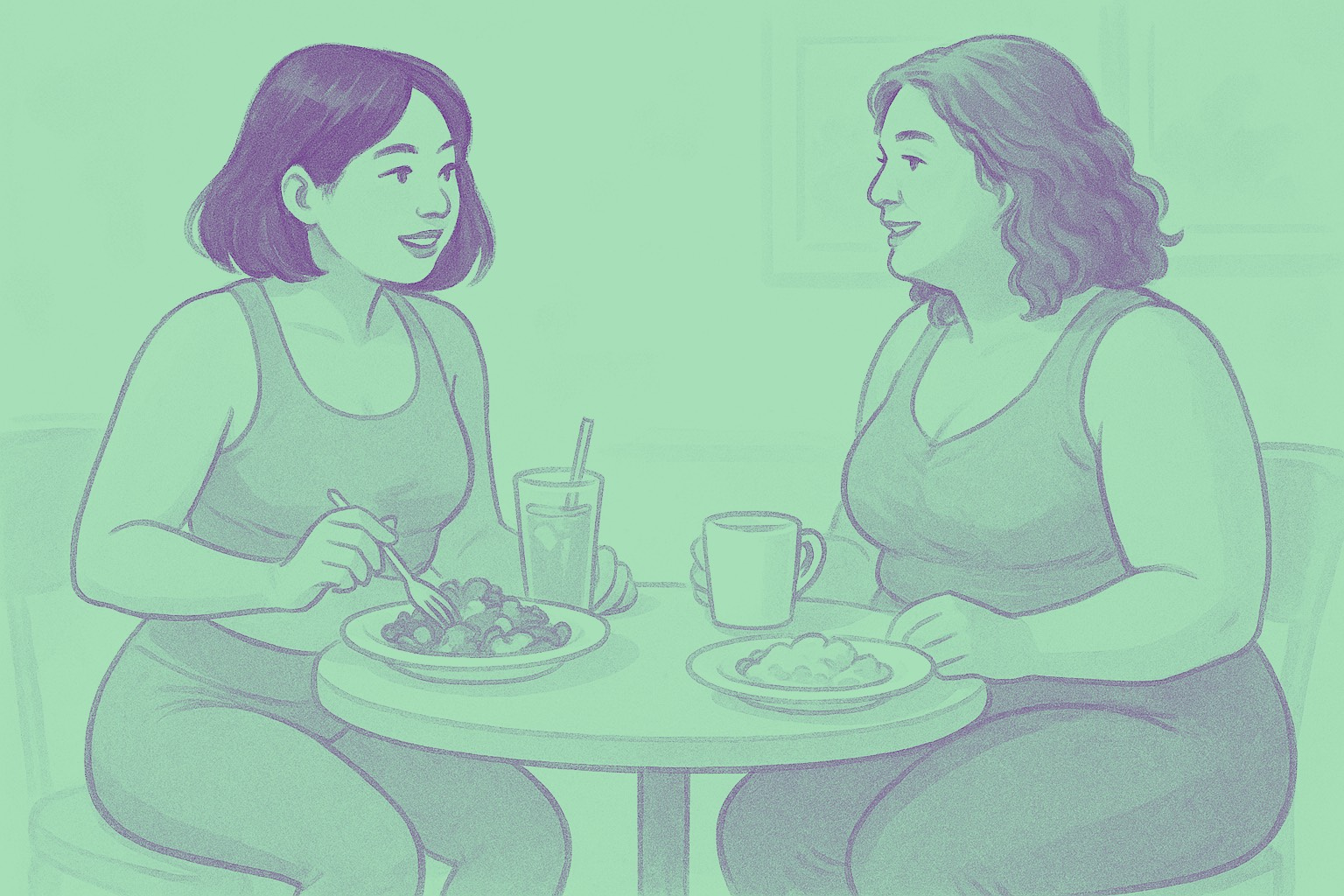
(The café is bustling but not loud. Light clatter of cups, distant conversations, occasional whirr of a coffee machine. OLIVIA is finishing a turmeric latte, her cheeks still faintly pink from pilates. XANTHIPPE sits opposite, hands around her oat flat white, her plate untouched — poached eggs, feta, mushrooms on sourdough.)
OLIVIA Are you gonna eat that or just try and make it levitate with your stare-o-vision?
XANTHIPPE (Smiling, still a bit dazed) I'm thinking. It's hard to eat and think at the same time. Well — not for everyone. But for me.
OLIVIA Alright. What's the brainwave you mentioned earlier?
XANTHIPPE Arithmetic. But not, like, equations. Just... the operations. Addition. Subtraction. Multiplication. Division.
OLIVIA I feel like you're underselling the sex appeal here.
XANTHIPPE (Laughs) I warned you I was boring. Or niche, depending on how generous you’re feeling.
OLIVIA Xanny! You’re not boring. You’re just... using a different operating system. (laughs)
(Beat)
So — how did you like pilates? Good, huh?
XANTHIPPE Surprisingly tolerable. The breakfast-with-you part I could get used to. The planking part... less so.
OLIVIA (Laughing) The secret is to suffer quietly. Like you’re being punished by a ghost.
XANTHIPPE Ugh, that kind of reminds me of being a friendless teenager at school.
OLIVIA You must’ve liked maths and science, at least. I mean, you get paid to teach the stuff now!
XANTHIPPE No, even maths.
OLIVIA Wait — you hated maths in school?
XANTHIPPE No, I was good at it. Just shy. I didn’t hand things in. Got anxious. Everyone thought I didn’t care, but I did. Just didn’t want to get it wrong in public.
OLIVIA That’s kind of endearing. Or tragic. Tragi-endearing. Anyway — go on. The maths epiphany?
XANTHIPPE Right. So. What if — and this is the part that’s been in my head for years — what if the basic arithmetic operations aren’t just ways of getting answers, but ways of generating patterns?
OLIVIA Like fractals? Mandelbrot stuff?
XANTHIPPE Not that elaborate. Just... imagine you took two numbers, any numbers — small or large, positive or negative — and applied one of the four operations. And you did that over and over, with millions of random pairs. What would the results look like, statistically?
OLIVIA I don’t know. Messy, I guess?
XANTHIPPE That’s what I think most people assume. But no. It’s patterned. Very patterned. Each operation generates a distinct statistical shape. It’s like... they’re not just buttons. They’re little machines that pump out specific kinds of structures.
OLIVIA What kind of shapes?
XANTHIPPE Multiplication gives you a bell curve. Most results land near zero, because multiplying by small numbers shrinks everything. So the middle swells up, and the edges fall away evenly — like a hill. That’s a normal distribution.
OLIVIA Why near zero though?
XANTHIPPE Because small numbers are common — and when you multiply by anything close to zero, the whole product shrinks. Multiply 0.1 by 3, you get 0.3. Multiply 0.1 by 0.2, and you're practically disappearing. Big numbers can blow things up, but they’re rarer. So everything clusters in the middle.
OLIVIA Okay. So — a hill, like you said. High in the centre, flat at the edges. Got it.
XANTHIPPE Then division. That’s different. If you divide one random number by another, assuming they’re both positive, you get this sharp spike around 1. Because any number divided by itself is 1. And a lot of close-ish numbers divide to roughly 1 too. But the second you divide by a tiny number — say 0.01 — the result blows up. So you get a peak at 1 and a steep cliff after.
OLIVIA So like a jagged little mountain?
XANTHIPPE More like a lopsided volcano. Spiky in the middle, but no graceful slope. Just a sudden drop.
OLIVIA Is that shape called anything?
XANTHIPPE It resembles a Poisson distribution. The kind you get with rare events — like how many people turn up at emergency, or how often you stub your toe.
OLIVIA So stubbing your toe is division’s fault. Good to know.
XANTHIPPE (Laughs) Then there’s subtraction. But only if you filter out the negatives. Like real life — you can’t have negative people in a room, or negative hours of sleep. So I was only interested in the the results if they were zero or higher.
OLIVIA Which makes sense. No one misses what they never had.
XANTHIPPE Exactly. When you subtract one random number from another filtering for that, most results are small — like 7 minus 6. But every so often, you get a big difference. That creates a long tail: a few huge results stretching way out. And here’s the twist — it’s not just a graph of loss. It’s the shape of the space between infinities. The leftovers. What survives the collision of two huge values. That’s what matter is. That’s what suffering is.
OLIVIA So... the present is a leftover?
XANTHIPPE In a way. It’s what persists after all the subtractions. It’s what's still there.
OLIVIA Huh. That’s... kind of beautiful? In a dark way.
XANTHIPPE And finally, addition. If you let both numbers be positive and negative, the outcomes spread out evenly. There’s no peak. Every result is just as likely. That’s a uniform distribution.
OLIVIA Wait — why does adding give you flatness?
XANTHIPPE Because the highs cancel the lows. You’re just as likely to add -3 and +5 as +3 and -5. The ups and downs smooth out across the board. It’s not noise. It’s peace. Inclusion.
OLIVIA Like the opposite of my emotional range.
XANTHIPPE (Laughs) Addition accepts everything. Doesn’t try to filter. And because of that, nothing dominates.
OLIVIA So it’s not chaos. It’s fairness.
XANTHIPPE That’s how I see it.
OLIVIA Xanny, I gotta say — for someone who just did their first plank, you’re pretty philosophical today.
XANTHIPPE Give me a good coffee and a few numbers and I’ll climb right out of my shell.
OLIVIA So what are you saying? That arithmetic explains the world?
XANTHIPPE Not all of it. But maybe how it feels. The shapes we keep bumping into — maybe they come from something deeper than psychology or history. Maybe they come from the way the one and the infinite meet.
OLIVIA That’s wild.
XANTHIPPE It gets wilder. But we’ll save that for next week.
OLIVIA Alright. But first — eat your bloody eggs.
XANTHIPPE smiles, finally picking up her fork.