

Intuition Wars: The Force Awakens
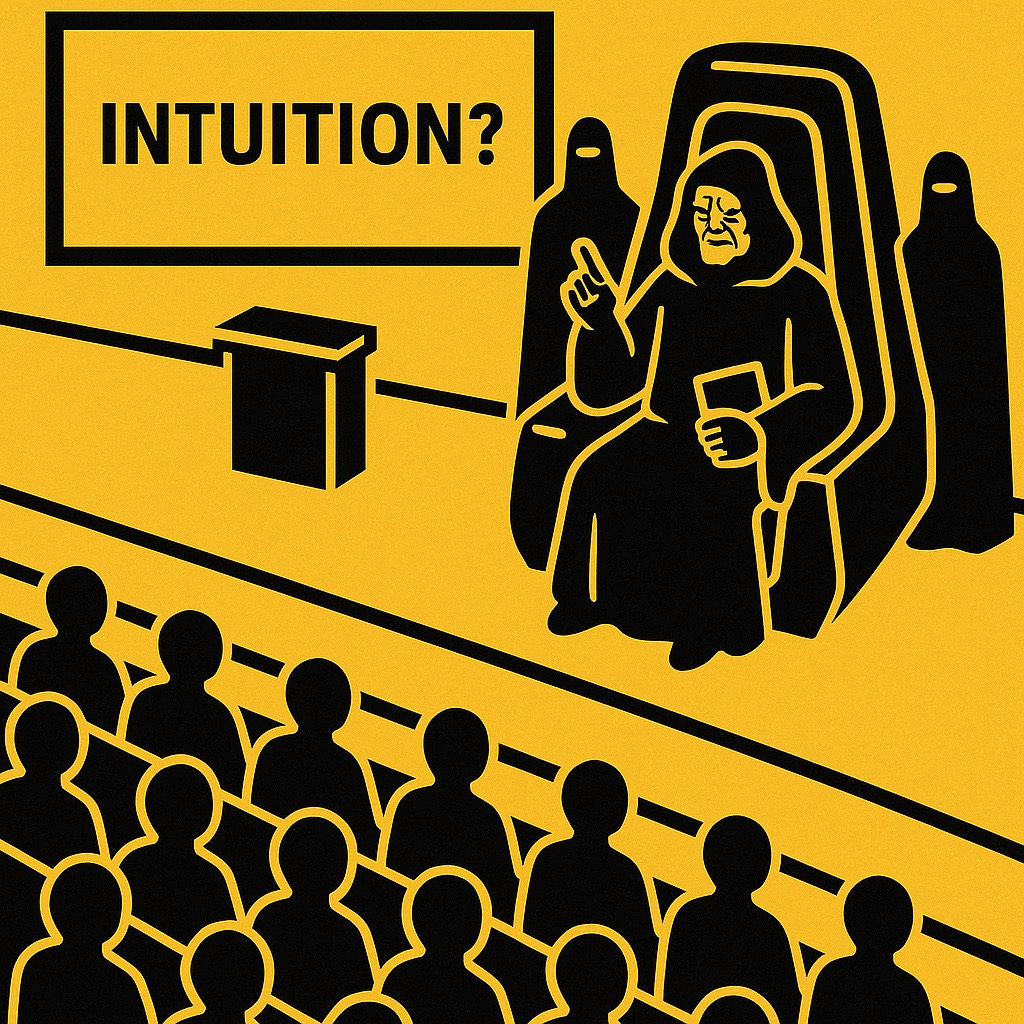
“Let the intuition wars commence,” writes Lance S. Bush - who along with ‘Bentham’s Bulldog’ at this point just might be the gravitational centre of philosophy on Substack.
He’s talking about the way analytic philosophers love to appeal to intuition. As in: “My intuition is…” followed by a claim that’s meant to sound self-evident. Bush isn’t having it. He’s sceptical not only of the habit but of the whole concept. He even wonders aloud whether he himself has intuitions at all - at least in the philosophical sense. Which, if you think about it, is a pretty interesting intuition to have.
It fits his pattern, though. Bush has questioned whether John Searle’s classic distinction between “subjective” and “objective” is even useful. That always caught my attention because, to me, his suspicion about intuition feels like part of the same conversation - about how we divide experience from knowledge, or feeling from thought.
Here’s how I frame Searle’s idea: Subjectivity can be undirected - raw, wordless experience - or directed, as in a personal opinion (say, which Tarantino movie actually works). Objectivity can be undirected - things that simply are, like molecules - or directed, like a report about a heist in The New York Times.
This maps almost perfectly into thoughts and feelings:
Feeling, undirected - pure contact with the world, sensation before reflection.
Feeling, directed - emotion shaped by comparison: pleasure, pain, desire, aversion.
Thinking, undirected - the easy play of curiosity, the mind’s quiet capacity to wonder.
Thinking, directed - analysis and judgement, the naming and measuring of things.
Together they make up the basic architecture of consciousness: two doors of feeling, two of thought.
And you can guess where intuition lives. In the wondering itself or ‘undirected thinking’. This is philosophy - the moment before we’ve started defending our views, when we’re just circling the question. I’m almost certain Bush still does this kind of wondering; otherwise his rejection of intuition would itself be a mystery.
The twist, of course, is that as soon as an intuition gets written down - say, in a Substack post - it stops being undirected. It becomes a thought about a thought. That’s why citing “intuition” is such a weird meta move: a reason disguised as an intuition.
But that’s not a reason to exile intuition from philosophy. Quite the opposite. It might just BE philosophy — the whole project of having a big ol’ think.
EDIT: An earlier version of the article mistakenly quoted Bush as writing “Let the intuition wars begin” instead of using the word ‘commence’.
I don't take myself to have undirected thinking. Under your model, I file my intuition-experiences as undirected feeling. That might explain why I take the "feelism over realism" position on a whole bunch of discourses.