Causation TL;DR
For those who thought the last email was too long
My last post on causation was a bit much. Frankly, it was too long and too abstract and not many people read it.
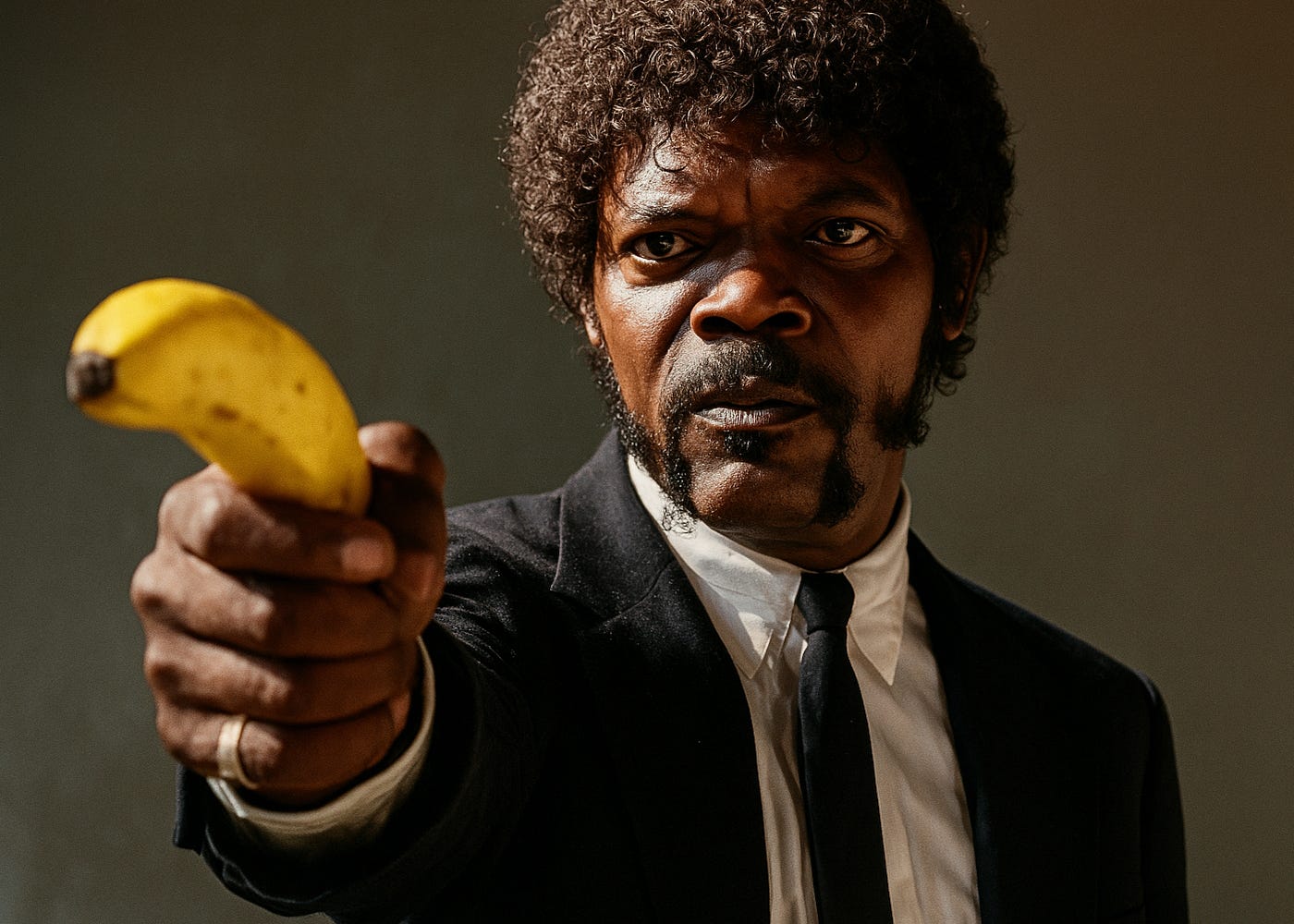
By contrast, my earlier post, Well That’s Just Your Opinion, Man, did much better. Possibly because it had a picture of ‘the Dude’ from The Big Lebowski at the top. Hence the picture included here from another cult film - Pulp Fiction - in hopes that that will be the spoonful of sugar to make the medicine go down.
So, let’s talk about causation.
One open question about causation is whether it actually is a coherent single idea at all - this seemingly quasi-mysterious force that makes stuff happen. But the verbs we actually use - “caused,” “because,” “emerges,” and “causes” - suggest to me that there are differences to how causation works. These words don’t just sound different. They point to different structures of sufficiency: different shapes of what counts as “enough” for something to happen.
Here’s the cheat sheet (with added Pulp Fiction):
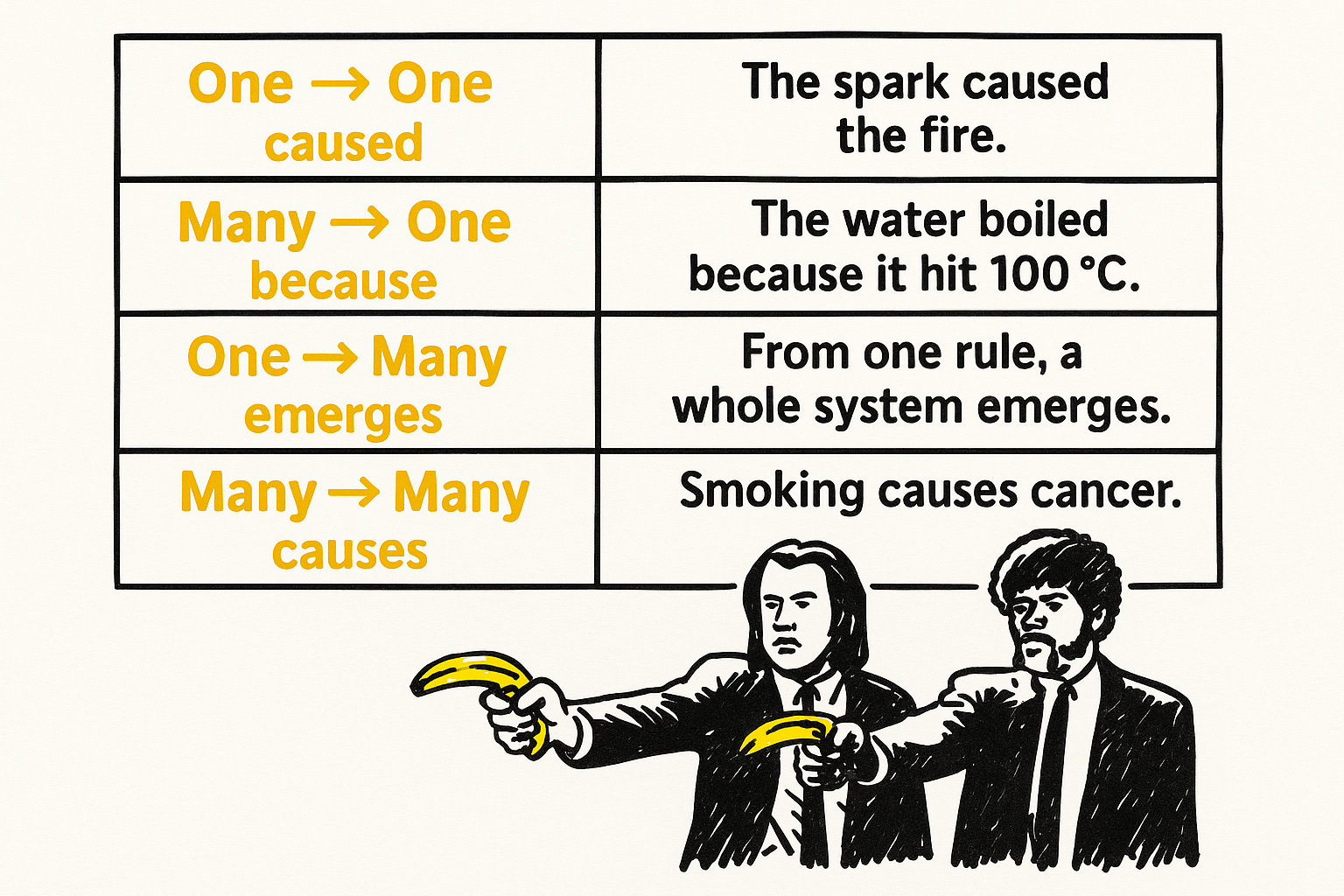
Each verb maps to a different logical structure - not just grammatically, but explanatorily. That’s the novelty. Once you spot it, you start seeing it everywhere.
Caused is One → One. A specific thing makes a specific thing happen. A token event leads directly to another. This is courtroom-style causation.
Because is Many → One. Many different instances can lead to the same result. It’s not about this water reaching 100°C—it’s about any instance matching the type. That’s called fungibility, and it’s great for reasoning.
Emerges is One → Many. The arrow flips. Those working in complexity will say: ‘a flock of birds is an emergent property of individual birds moving’ - so we can see this is a single flock guaranteeing there being many individual birds..
Causes is Many → Many. No single input maps cleanly to a single outcome. But across time, agents, and probability, the pattern holds. This is the domain of science, policy, and machine learning.
That’s the framework: four verbs, four arrows, four ways one thing can be enough for another. It doesn’t settle the metaphysics of causation, but it does explain why we reach for different verbs in different contexts - and how each one encodes a different logic of explanation.
Thanks for reading. If you want the big version (quantum physics, emergence and more) it’s here. But this is the core.
Causation isn’t one verb. It’s four.
Each one points in a different direction.
And yes - that is Jules holding a banana.
Because…